In the budget of August 2024, the Government announced sweeping changes to Inheritance Tax Rules (IHT). Many of our clients are rightly concerned about what these changes may mean for them and their families.
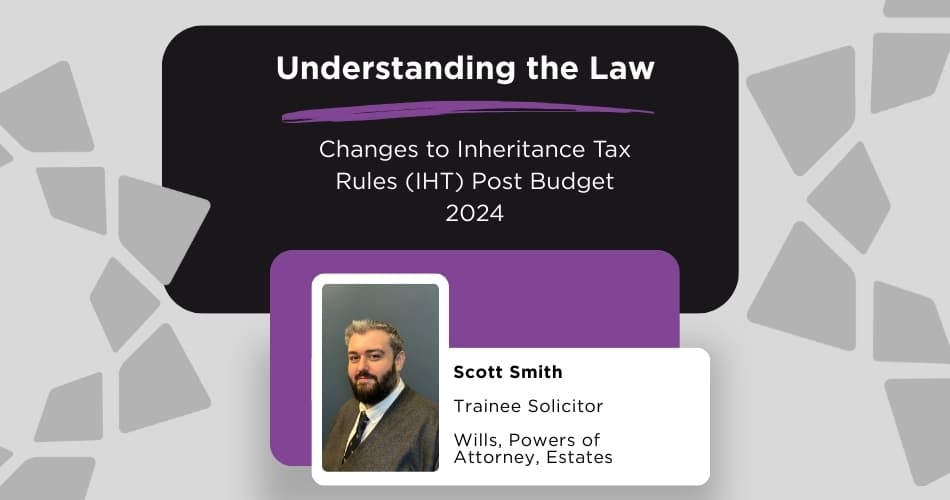
Scott Smith from our Private Client Team breaks down the complexities of IHT – and what the forthcoming changes mean for you.
Given the uncertainty surrounding the reforms, it is more important than ever to be in the know on what the rules and regulations around paying IHT are.
Understanding the Changes to Agricultural Property Relief and Business Property Relief Coming in 2026
You may be wondering what Agricultural Property Relief (APR) and Business Property Relief (BPR) are?
APR and BPR are Inheritance Tax Reliefs which can be used to exclude either 50% or 100% of the value of certain assets from being included in Inheritance Tax calculations. The type and rate of relief depends on the type of property the relief is being applied to. For example, land which has been used for farming would come under APR, but the machinery used to farm the land would fall into BPR. You cannot apply both APR and BPR to the same asset, it can only be applied to one or the other.
As the law currently stands both APR and BPR operate independently and there is no cap on how much APR and BPR can be applied for. This is, however going to change from next year.
As of April 2026, a cap of £1 million will be applied to the 100% exempt APR and BPR, meaning that only £1 million worth of property can be written off completely. This cap will apply to APR and BPR jointly, meaning you will only be able to write of 100% of the value of both agricultural and business assets. Any assets which would fall into APR or BPR over the £1 million cap would have 50% APR and BPR applied to them (which means only half of the assets value would be taxed). The government has also set up provisions to allow any IHT which is due to be paid over 10 years, interest free.
As is to be expected, these changes have not gone down well with farmers who are concerned about the impact on future generations.
Understanding Pension Changes and How They Will Affect IHT
Alongside the changes to APR and BPR are updates to pensions. These changes have more direct repercussions on the payment of IHT.
Historically, pensions have been completely excluded from IHT calculations, but this will no longer be the case.
In the Autumn Budget of 2024, the Government announced that, from 6 April 2027, they would bring any unused pension funds and death benefits payable from a pension into a person’s estate for inheritance tax purposes.
The gravity of this cannot be overstated as this will impact everyone who has money in their pension pot. Any money which is left in your pension pot when you die could be included in any IHT calculation. It may be an idea to speak to your financial advisor to see what options are available to you to mitigate or minimise any potential IHT liability due.
Planning for the Future Now – What you can do about it?
Fortunately, there are steps you can take to look to minimise and potentially mitigate your exposure to IHT
Nil Rate Bands.
It’s important we understand Nil-Rate Bands. This is the threshold which an estate much reach to be considered for IHT. A person’s net estate must reach a value of £325,000 before IHT can be applied.
- If you own your home and are leaving it to a direct descendant (such as your children or grandchildren), then a further £175,000 exemption exists called the Main Residence Nil-Rate Band. Applying this to your estate together with the Nil Rate Band can bring your total exemptions to £500,000.
- If you are married or in a civil partnership and your spouse or partner pre-deceases you, then any unused amount of their Nil-Rate Bands can be added to your own Nil-Rate Bands to be used. This is called the Transferable Nil-Rate Band meaning that you potentially have up to a £1 million threshold before IHT would be applicable, being 2 Nil Rate Bands of £325,000 and 2 Main Residence Nil Rate Bands of £175,000.
Gifts
Gifts are also an excellent way in which to minimise your IHT liability.
Some gifts are completely exempt from Inheritance Tax no matter the size of the gift made. The most common of these exemptions are gifts made to your spouse or civil partner. Assets passing between spouses and civil partners are made completely tax free.
You can also gift up to £3,000 per year tax free known as the annual exemption. You can carry any amount of the £3,000 you do not use over into the next tax year for one year only. There is also what is called the small gift exemption. This is separate from your annual exemption and allows you to gift up to £250 to as many individuals as you wish during a tax year.
Lastly, there exists what is commonly referred to as the 7-year rule. This is an Inheritance Tax Relief which can be applied to gifts which are larger than the tax-free threshold. These types of gifts are called Potentially Exempt Transfers (PETs). PETs only become exempt from IHT should the gifter live more than 7 years after the gift was given. If they die within that 7-year period, then gifts given 3 to 7 years before your death are taxed on a sliding scale known as “taper relief”.
One way you may not have considered to reduce your Inheritance Tax liability is simply to spend your money!
Although not a commonly used IHT tool, this can be effective in reducing any exposure your estate may have to IHT. The theory being that the less you have when die, the less (if any) IHT your estate will require to pay. You’ve have worked very hard for your money; it’s about time you enjoyed yourself! Take that holiday you’ve always dreamed of taking. Eat that meal you’ve always wanted to eat. As they say, “you can’t take it with you”.
As you will see, there are many options open to you when it comes to estate planning. By discussing matters with our expert solicitors together with choosing an appropriate financial adviser, a holistic approach to your estate will result in better outcomes for your family and those left behind.
Please don’t hesitate to contact our specialist team who would be delighted to assist you.